Bicep exercises with dumbbells and at home
Dumbbell, hammer and concentration curls, 8 to 12 reps, at least twice a week. No weights? Use filled bottles. But if you do pull-ups, or machine pulldowns, extra curls may add less than you think.
On this page
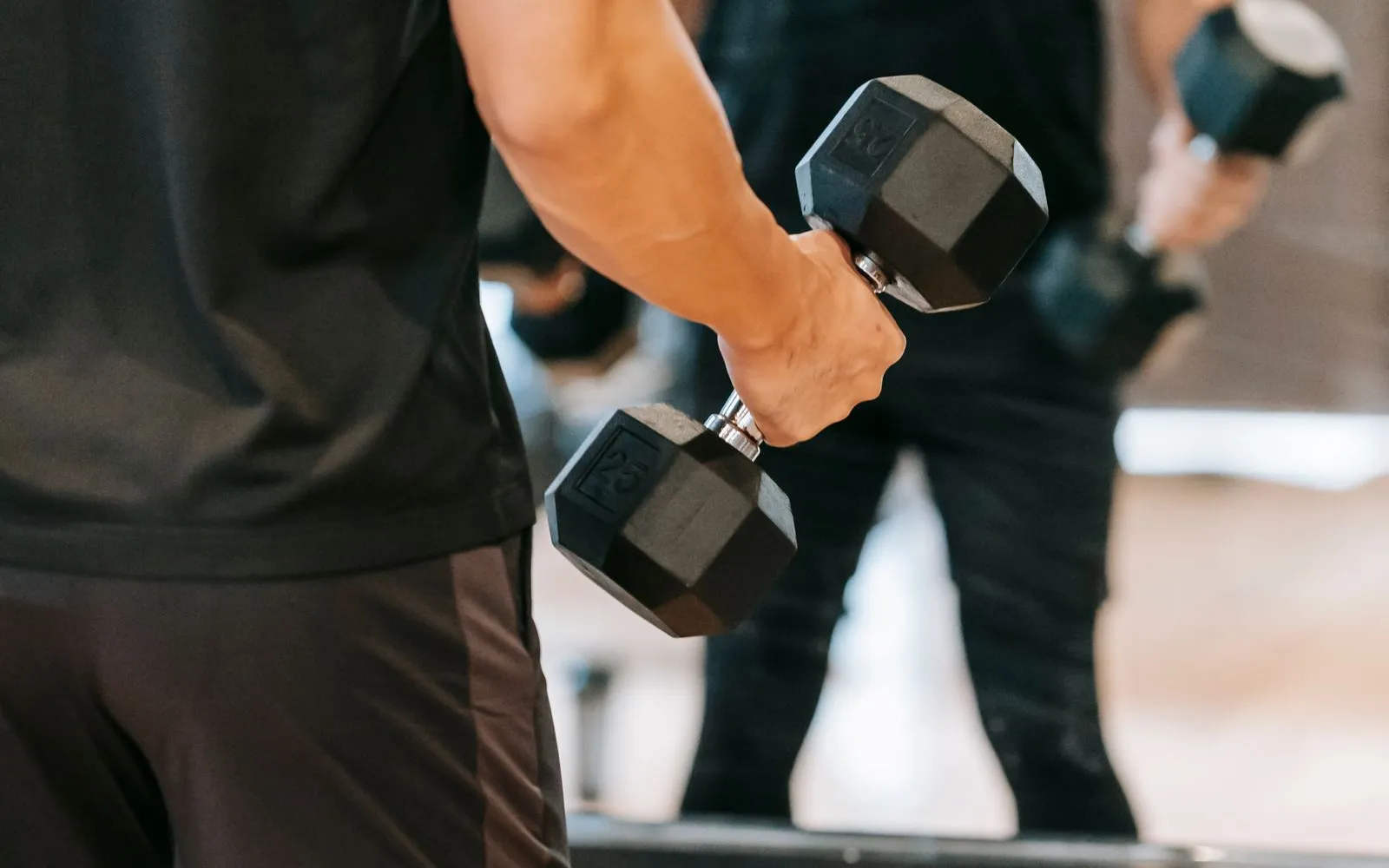
What are the best bicep dumbbell exercises?
Curls. A dumbbell curl, a hammer curl and a concentration curl cover most of what you need.
Do 8 to 12 reps of each, for 2 or 3 sets, on at least 2 days a week. That’s the NHS advice for any strength move.
| Curl | Grip | How |
|---|---|---|
| Dumbbell curl | Palms forward | Stand with a weight in each hand. Curl them up in front of you, then lower under control. |
| Hammer curl | Palms facing each other | The same curl with your palms in the whole way. It works your forearms too. |
| Concentration curl | One arm at a time | Sit with the back of your arm against your inner thigh. Curl up, then lower slowly. |
| Incline curl | Palms forward, on a bench | Sit back on a tilted bench, arms hanging. The tilt stretches the biceps and mostly stops you swinging. |
Sources: Catalyst Athletics: curl; hammer; concentration; incline
Which works the biceps hardest? In a study of 16 young adults funded by ACE, a US fitness body, the concentration curl gave the most biceps activity of 8 moves. Your arm pressed on your leg stops it swaying.
That study measured effort in a set, not growth over weeks. And the researchers saw a catch: it works the biceps and little else.
Pick two curls from the table and do them twice this week.
How many sets and reps for biceps?
Pick a weight you can lift 8 to 12 times, or reps. Stop when another rep would be hard without help. The NHS calls that 1 set.
Do at least 2 sets. The NHS says 3 sets give even more benefit.
Start light, then build up over weeks
- 1
Start
Light weights. 3 sets of 5 curls with each arm, slow up and slow down.
- 2
Add reps
Build up a few reps at a time until you reach 8 to 12 a set.
- 3
Make it hard
End each set when one more rep would be hard without help.
- 4
Go heavier
When 12 good reps feel easy, pick a heavier weight.
Sources: NHS: strength exercises; NHS: how to improve strength
The first three steps are the NHS’s. Going heavier at 12 reps is a simple rule of thumb, not a study finding.
More on adding weight safely: progressive overload for beginners.
Bicep exercises at home with no weights
Use bottles, a bag or your own body weight. The NHS biceps curl uses filled water bottles, and you can do it sitting down.
| Move | You need | How |
|---|---|---|
| Water-bottle curl | Two filled bottles | Arms by your sides. Bend them until the bottles reach your shoulders, then lower slowly. |
| Bag curl | A backpack or shopping bag | A home take on the NHS curl. Hold the handle, palm up, and curl. Add books or tins to make it heavier. |
| Chin-up | A pull-up bar | Hang with your palms facing you. Pull your chin up to the bar, then lower slowly. |
| Inverted row | A low bar or rings | Hang under the bar, body straight. Pull your chest up, then lower under control. |
Sources: NHS: strength exercises; ACE; Catalyst Athletics
The chin-up was one of the 8 biceps moves in the ACE study. Catalyst Athletics, a weightlifting coaching library, uses the inverted row for the back and arms.
Can’t do a chin-up yet? Start with inverted rows. Catalyst changes the bar height to change how hard they are.
Got a band? The resistance band workout includes a curl.
Do I need curls if I do pulldowns or pull-ups?
Maybe not at first. Pulling moves already train your biceps.
In a 10-week trial, 29 young men new to training did lat pulldowns and bench press. One group also did curls and a triceps move. A pulldown is the machine version of a pull-up.
The muscle at the front of the arm grew by about the same in both groups: 6.5% without curls and 7.04% with them.
A second trial of 20 untrained men found a different result. Adding single-joint moves, such as curls, grew arm size a little more, 5.2% against 4.0%. Both trials were small and short.
So do your pulls first. Add curls if you want more arm size, or if you don’t do any pulling moves.
How do I get bigger biceps?
Hard sets, a few more of them over time, and patience.
Light or heavy both work. A review of 21 studies found light weights built similar muscle to heavy ones, when every set went until another rep was impossible. Heavy weights did more for the most you can lift once.
More sets tend to grow more. In a review of 15 studies, each extra set a week was linked to about 0.37% more gain.
Gains vary a lot. In 585 adults who trained one arm for 12 weeks, biceps size changed by anything from -2% to +59%. So compare your arms with how they were, not with someone else’s.
Your biceps week
- Train your biceps on at least 2 days a week.
- Do two curls, such as a dumbbell curl and a concentration curl, for 2 or 3 sets each.
- Use a weight you can lift 8 to 12 times.
- End each set when one more rep would be hard without help.
- Add chin-ups or inverted rows if you can.
- When 12 good reps feel easy, pick a heavier weight.
Sources: NHS: how to improve strength; Schoenfeld 2017
Muscle needs food too. See how much protein to build muscle. For a full plan, try the two-day strength routine.
When to speak to a GP
Elbow and arm pain is not usually a sign of anything serious, the NHS says. Get help if:
- You haven’t exercised for some time, or you have medical conditions or concerns. The NHS says speak to your GP first.
- Elbow or arm pain doesn’t go away after a few weeks. See a GP.
- Your arm hurts when you exercise but the pain goes away when you rest. Or it’s swollen and you have a very high temperature, or feel hot, cold or shivery. Get help from NHS 111.
- You heard a snapping noise or your arm changed shape when you hurt it. Or you have severe pain and it’s hard to move, or it tingles or feels numb. Go to an urgent treatment centre or A&E.
- Arm pain comes on suddenly with pressure, heaviness or squeezing across your chest. Call 999.
Sore for days after a new workout? See muscle soreness or progress.