What is the right desk height, sitting and standing?
Just below your elbows, sitting or standing. For most adults sitting down, that means a desk of about 71 to 76 cm. A standing desk goes higher, to your own standing elbow height.
On this page
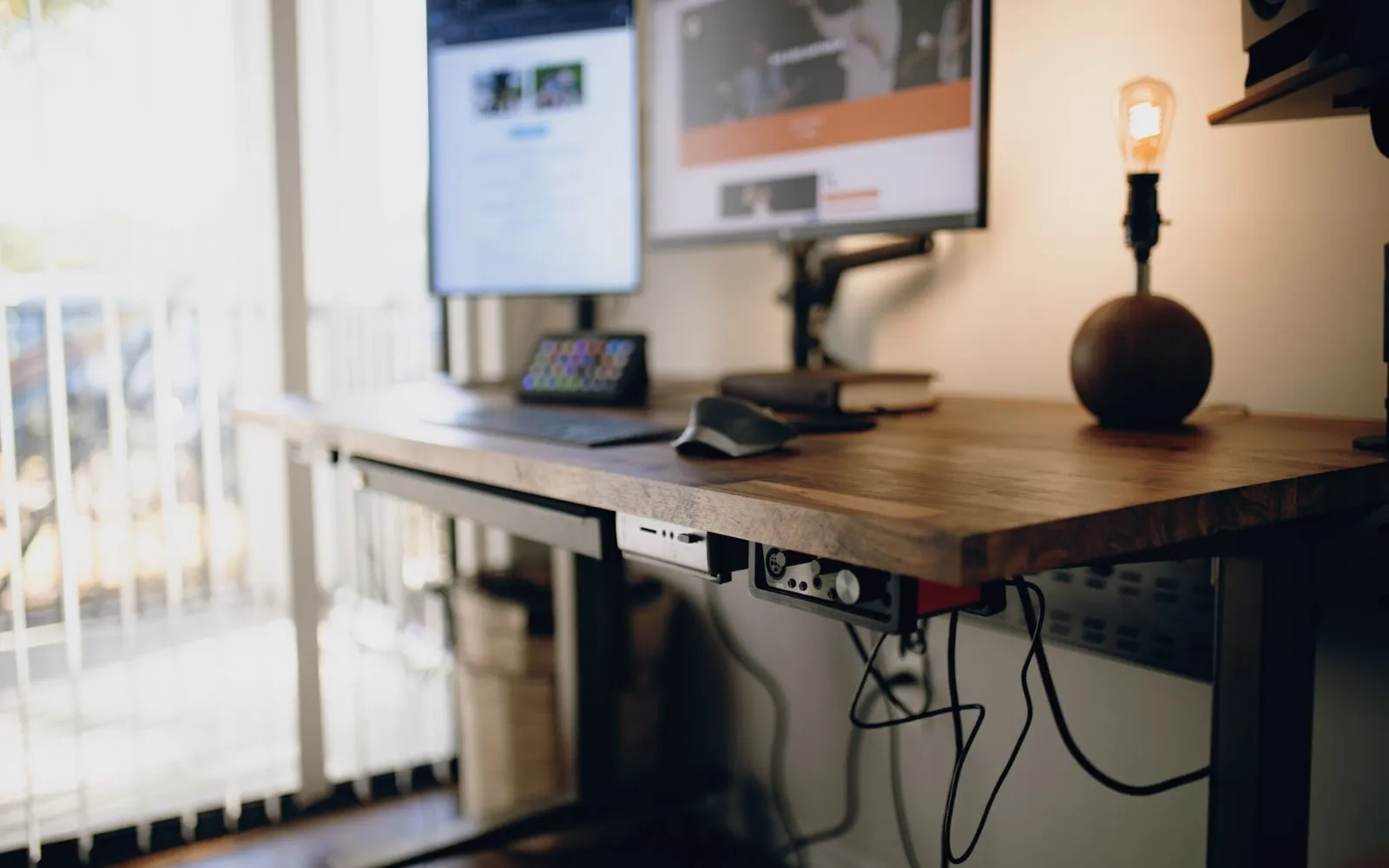
What is the right desk height?
The right height puts your keyboard just below elbow height, with your shoulders relaxed. That’s the Health and Safety Executive (HSE) setup for screen work.
Your forearms should be about level with the floor. If you have to shrug to reach the keys, the desk is too high for you.
| Part | Where it goes |
|---|---|
| Keyboard | Just below elbow height, in front of you. |
| Shoulders | Relaxed. No shrugging to reach the keys. |
| Forearms | About level with the floor. |
| Screen | Top level with your eyes, about an arm’s length away. |
| Mouse | In line with your elbow. |
| Seat | Supports the front and back of your thighs, with a 2 to 3 cm gap behind your knees. |
Sources: HSE; HSE INDG36
Sit at your desk now and check the first two rows. They tell you if the height works.
What is the standard desk height?
Cornell University’s guide to setting up a desk says a flat desk 28 to 30 inches high suits most adults. That’s about 71 to 76 cm.
The HSE guide gives no height in cm. It works from your body instead. A tall and a short person need different heights.
So skip the charts and measure your own.
Find your own desk height in 4 steps
- 1
Sit back
Seat supports your thighs, with a 2 to 3 cm gap behind your knees.
- 2
Drop your shoulders
Let your arms hang loose. No shrugging.
- 3
Bend your elbows
Forearms about level with the floor.
- 4
Measure
Floor to just under your elbow. Your keyboard sits just below that.
Sources: HSE; HSE INDG36
Write the number down. Use it when you buy a desk or set a standing one.
Desk too high or too low? Move the chair
A fixed desk can’t move, but an office chair usually can. That’s why the chair is your adjuster.
| Problem | Fix |
|---|---|
| You shrug to reach the keys | Raise the seat, or sit on a cushion. |
| Your feet don’t reach the floor after that | Add a footrest. HSE says it may help, particularly for smaller people. |
| You hunch down to the keys | Lower the seat until your forearms are level. Keep the gap behind your knees. |
| No room for your legs | Clear the space under the desk so you can move your legs. |
| You work on a laptop | Use a separate keyboard and mouse, and raise the screen on a riser. |
Sources: HSE; HSE INDG36
Keyboard still too high on a fixed desk? Cornell suggests a height-adjustable keyboard and mouse tray fixed under the desk.
Screen too low once you’re set? Raise the screen, not the desk. Cornell says a low screen makes you crane your neck forward, which forward head posture covers in more detail.
What height should a standing desk be?
Use the same rule standing up. Set the keyboard just below your elbows, with your forearms about level.
Cornell explains why. Too low bends your wrists back. Too high keeps your elbows bent the whole time.
Don’t stand all day, though. Cornell says standing still is even more tiring than sitting still, so it’s the switching that counts.
| How long after | Less sitting at work each day |
|---|---|
| Up to 3 months | About 100 minutes |
| 3 to 12 months | About 57 minutes |
| After a year | No evidence yet |
Source: Cochrane review
The Cochrane review rates this evidence as low quality, and says the effect is likely to fade. Cornell sees the real benefit as the change between sitting and standing, so swap between the two through the day rather than standing for hours.
How often should I get up from my desk?
Often, and briefly. The HSE says 5 to 10 minutes every hour is better than 20 minutes every 2 hours.
In one small trial, breaks of 1 to 2 minutes every half hour cut sitting at work by about 40 minutes a day. That was compared with two 15-minute breaks. Cochrane rates this evidence as low quality.
Gym three times a week? The NHS says you can hit your activity target and still be at risk of ill health. That’s if you sit or lie down for the rest of the time.
Your desk height checklist
- Set your keyboard just below elbow height, with your shoulders relaxed.
- Put the top of your screen level with your eyes, about an arm’s length away.
- Raise the seat or add a cushion if you shrug, and add a footrest if your feet then don’t reach the floor.
- Leave a 2 to 3 cm gap between the front of the seat and the back of your knees.
- On a laptop, use a separate keyboard and mouse and raise the screen on a riser.
- Take 5 to 10 minutes away from the screen every hour, rather than 20 minutes every 2 hours.
Sources: HSE; HSE breaks; HSE INDG36
Need ideas for those breaks? Try exercise snacks or a few posture exercises.
When to speak to a GP
The NHS lists bad posture, such as sitting at a desk for a long time, as one cause of neck pain. See a GP if:
- Neck pain or stiffness does not go away after a few weeks, painkillers like paracetamol or ibuprofen have not worked, you’re worried about it, or it comes with pins and needles or a cold arm.
- Back pain does not improve after a few weeks of home care, stops your daily activities, or you’re worried about the pain or struggling to cope.
- Back pain does not improve after resting or is worse at night, is worse when you sneeze, cough or poo, or comes from the top of your back between your shoulders.
- You have back pain with weight loss you can’t explain, a lump or swelling, or your back has changed shape.
- Pain, stiffness, tingling or numbness from repeated tasks like typing (RSI) is not going away or is getting worse.
With back pain, ask for an urgent GP appointment or call 111 if you feel hot, cold, shivery or generally unwell. Do the same if the pain is severe and sudden, or worsening fast.
Call 999 or go to A&E if back pain comes with:
- Pain, tingling, weakness or numbness in both legs.
- A loss of feeling around your genitals or anus.
- Changes in your bladder or bowels.
- Changes in how sex feels, including erection or orgasm problems.
- Chest pain, or it follows a serious accident.
In many areas you may be able to refer yourself to NHS physio without seeing a GP. For gentle moves meanwhile, see neck exercises and lower back stretches.