How do I check my pulse?
Count your wrist beats for 30 seconds, then double it. On a pulse meter, it’s the bpm number. Adults at rest are usually 60 to 100. But a number can’t show your rhythm.
On this page
How do I check my pulse?
You need two fingers and a clock. The BHF says to put your first and middle finger on the inside of your other wrist, at the base of your thumb.
Press lightly. If you can’t feel anything, press slightly harder.
Then count the beats for 30 seconds and double it. So 34 beats in 30 seconds is 68 beats a minute (bpm).
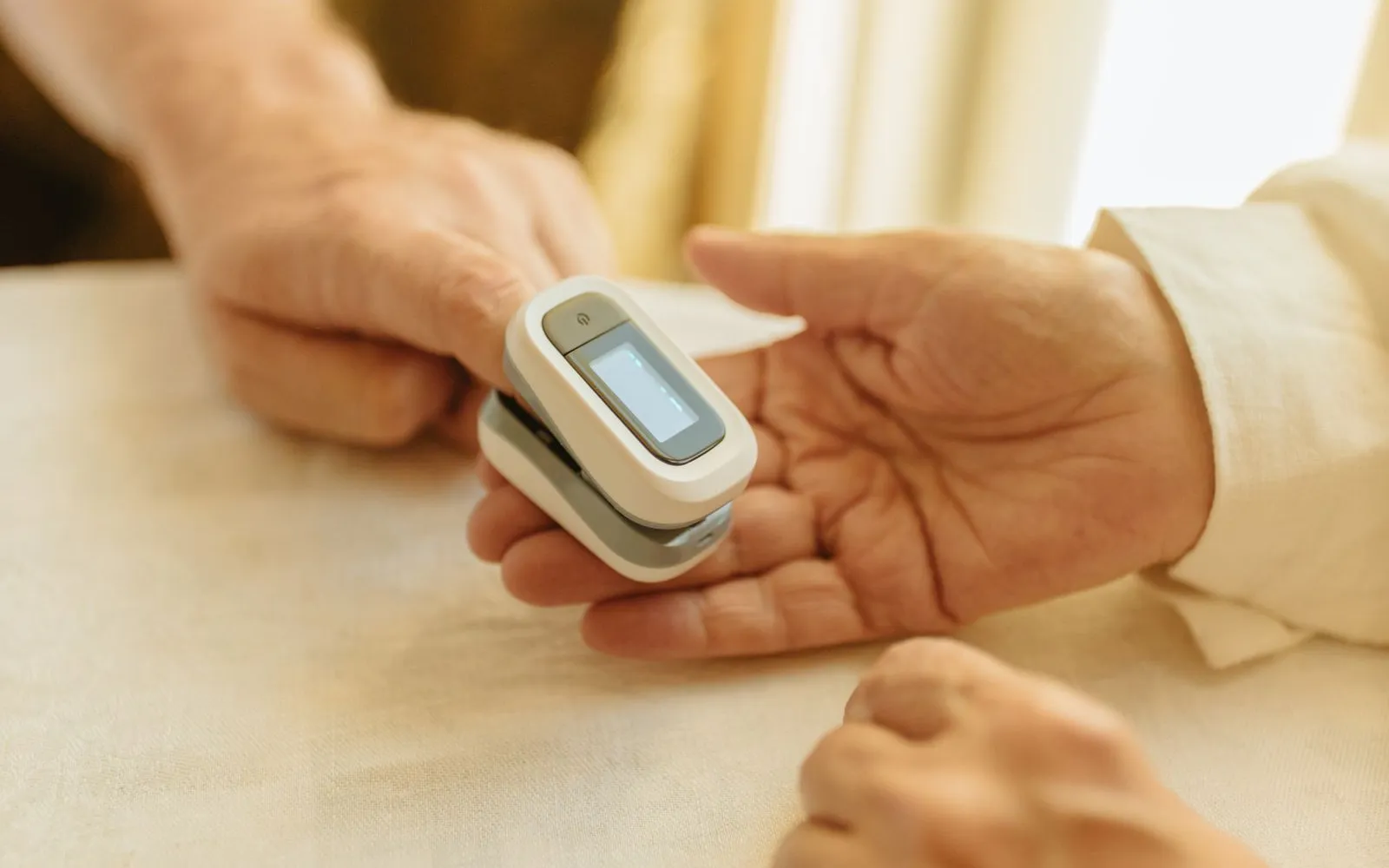
Using a finger pulse meter instead? Your pulse is the number marked bpm. Keep it on for at least a minute so the number can settle.
Check your pulse in four steps
- 1
Rest first
Sit or lie down for 5 minutes. No smoking or caffeine before.
- 2
Find it
First and middle finger on the inside of your wrist, below the thumb.
- 3
Count
Count for 30 seconds and double it, or count for a full 60.
- 4
Feel the rhythm
Is it regular and steady? If not, count for a full 60 seconds.
Source: BHF
Can’t find it at your wrist? Sit or lie down and try your neck, just below your jaw, next to your windpipe. Press gently.
For an accurate reading, the BHF says to check at the same time every day. Pick a time now, such as before breakfast.
What is a normal pulse reading?
For adults at rest, the BHF says it’s usually between 60 and 100 bpm. Some people sit outside that range.
- Below 60 bpmSlow for most at rest. Can be normal if very fit, asleep or on beta blockers.
- 60 up to 100 bpmUsual for adults at rest.
- Above 100 bpmFast for most at rest. Fine during exercise.
Sources: BHF: heart rate; BHF: pulse
Think of your heart like a car engine: it ticks over when parked and revs on the motorway, which is what it’s built for.
So a pulse over 100 is fine during exercise. A fast pulse at rest, or for no obvious reason, is the one to get checked by your GP.
Your pulse also rises if you’re dehydrated, unwell or have a fever. Some asthma medicines speed it up. Beta blockers (medicines for the heart and blood pressure), such as bisoprolol, can lower it.
Never stop or change a prescribed medicine without your prescriber.
More on your number: normal resting heart rate, a low resting heart rate and your heart rate when asleep.
Is my heartbeat regular?
This is the part a number can’t show. It’s your rhythm. The BHF says a normal rhythm is regular and steady, like a clock ticking.
| What you feel | What to do |
|---|---|
| Regular and steady beats | Nothing. This is a normal rhythm. |
| A missed beat here and there | Nothing to worry about. Check with your GP if you’re unsure. |
| No set pattern, beats of different strengths | Count for a full 60 seconds. If you’re concerned, talk to your GP. |
Sources: BHF: pulse; BHF: AF
An uneven pulse could be a sign of a heart rhythm problem, such as atrial fibrillation (AF). With AF, the beats have no set pattern. It’s more likely if you’re 65 or older.
AF sometimes has no symptoms. So feel the rhythm each time you count.
How do I read a pulse meter?
A finger pulse meter, or pulse oximeter, shows two numbers. The one in bpm is your pulse rate. The one in % is the oxygen in your blood.
| On the screen | What it means |
|---|---|
| Number marked bpm | Your pulse rate, in beats per minute. |
| Number marked % | The oxygen level in your blood. |
| Moving wave or bar | The beat it’s picking up. Look for a regular wave. |
Sources: Walsall Healthcare NHS Trust; Cambridge University Hospitals
Which number sits on top depends on the meter. On one NHS hospital’s meter, the top number is heart rate. Go by the label, not the position.
Six steps to a steady pulse meter reading
- Rest for at least 5 minutes first.
- Take off any nail polish or false nails on that finger.
- Warm your hands, as cold fingers can throw the reading off.
- Use your index or middle finger.
- Rest your hand on your chest and hold still. Don’t squeeze the clip.
- Wait at least a minute, or longer if the reading keeps changing.
Source: Walsall Healthcare NHS Trust
Bought one for oxygen? The MHRA, which regulates medical devices, doesn’t recommend home use unless a clinician advised it, showed you how, and is reviewing your results. For your pulse, your fingers and a clock do the job.
Are heart rate watches accurate?
Fairly, but it depends what you’re doing. A 2017 study of 50 healthy adults checked chest straps and watches against a hospital heart trace (ECG).
| Device or exercise | Result in the 2017 study |
|---|---|
| Chest strap | Closest match to the ECG overall. |
| Wrist watches on a treadmill | All but one did well. |
| Wrist watches on an exercise bike | Only some were close enough. |
| Cross-trainer, using the arm handles | No device was accurate. |
Source: Gillinov et al, 2017
Those were 2017 models, so newer ones may differ. When the number really matters, the authors advise a chest strap.
Some watches flag an uneven rhythm. The BHF says this can help you notice AF, but only a healthcare professional can diagnose you.
Got an alert? Feel your pulse for 60 seconds, and talk to your GP if you’re concerned.
Training by heart rate? See max heart rate and exercise zones.
When to speak to a GP
Book an appointment if:
- Your pulse is fast when you’re at rest, or for no obvious reason.
- Your pulse is under 60 and you feel faint, dizzy or very tired, or you’ve fainted.
- Your pulse is often uneven, or you think you may have symptoms of AF.
- Your heart rate changes after you start a medicine.
- Palpitations (when your heartbeat suddenly feels fast, pounding or fluttering) keep coming back, are getting worse or last longer than a few minutes. Or you get them and have a heart condition or heart problems in your family.
Call 999 or go to A&E if you have palpitations now that do not go away. Also call 999 if your heartbeat is fast or uneven now and you have chest pain, shortness of breath, sweating, or feel or are sick.
Also call 999 for a fast or uneven heartbeat with fainting, dizziness, falling over or a severe headache. The same goes for weakness or numbness on one side, blurred vision, loss of sight, confusion or trouble speaking. Don’t drive yourself to A&E.
Had palpitations with chest pain, breathlessness or fainting that have now stopped? Ask your GP surgery for an urgent appointment or call 111.