How to improve grip strength
Carry, hang and squeeze, 2 or more days a week. A hand gripper trains only one of your three grips. The grip that holds a heavy bag needs different work.
On this page
What are the best grip strength exercises?
The best ones make you hold, carry or squeeze something heavy. IronMind, a grip training publisher, splits the work into three grips: squeezing (crush), holding on (support) and pinching.
The NHS advises strength work for all your main muscles, arms included, on at least 2 days a week. Keep going until you need a short rest.
| Exercise | Grip it trains | How to start |
|---|---|---|
| Farmer’s walk | Support | Walk 25 to 50 yards holding a heavy dumbbell in each hand. Loop a towel round each handle to make it harder. |
| Dead hang | Support | Hang from a pull-up bar, palms facing away. Aim for 15 seconds, then 30, 45 and 60. |
| Plate pinch | Pinch | Pinch a weight plate, fingers on one side and thumb on the other. Lift it and hold for 5 seconds, 5 to 10 times. |
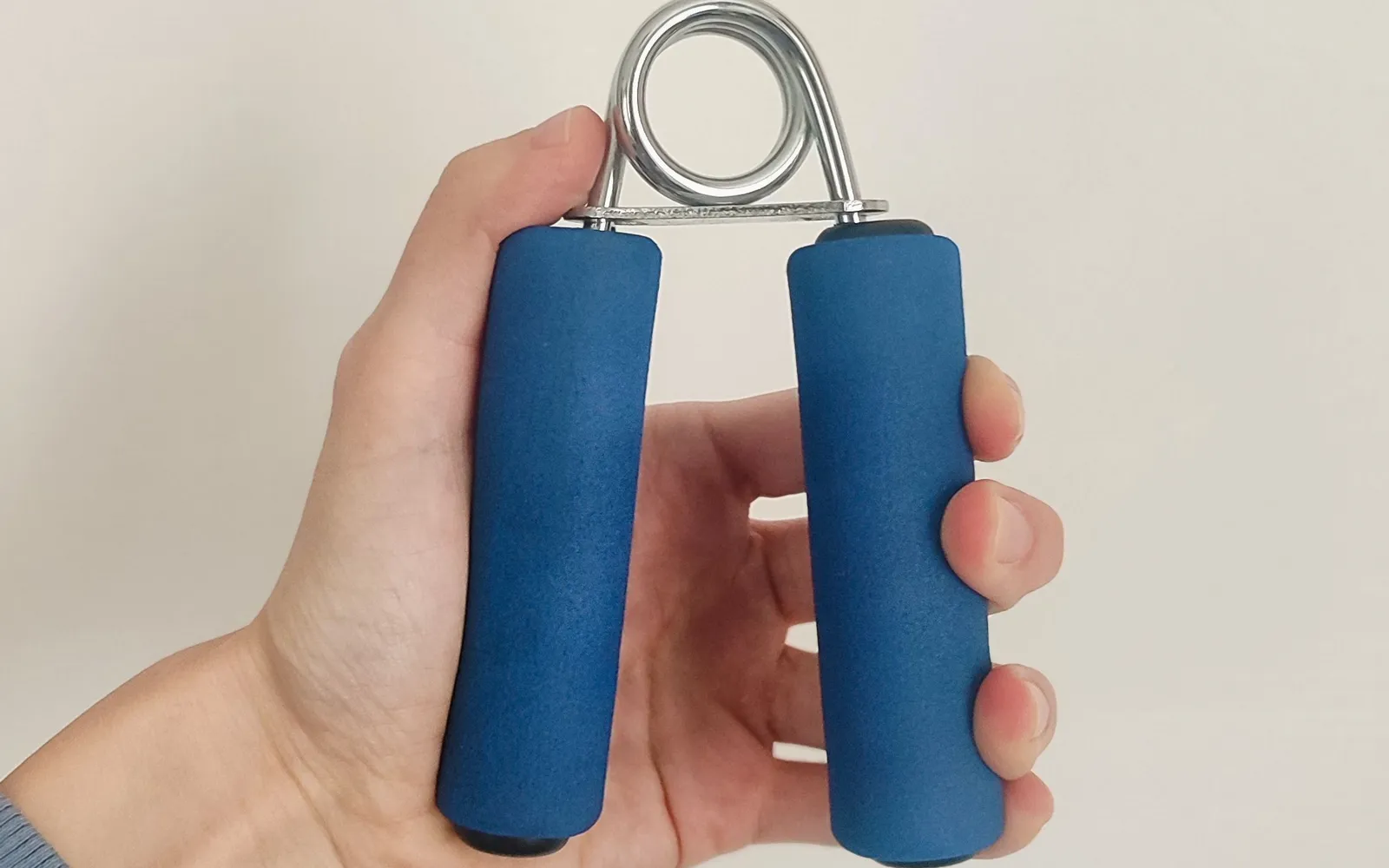
| Hand gripper | Crush | 1 to 3 hard sets of 5 to 7 reps, after an easy warm-up. |
| Finger band | Opening the hand | Put a rubber band round your fingertips and open your hand against it. |
| Heavy shopping bags | Support | Carry them home. The NHS counts this as strength work. |
Sources: Mark Barroso, Spartan coach; IronMind; NHS
The grip that holds a heavy bag is your support grip. Farmer’s walks and hangs train it. A gripper trains your crush grip, and plate pinches train your fingers against your thumb.
Climb? You hang from holds and pinch them, so hangs and plate pinches are the closest match.
Next session, add one carry or hang and one squeeze.
Why does grip strength matter for health?
Because in large studies, a weaker grip was linked to a higher risk of dying early.
Researchers followed half a million UK adults aged 40 to 69 for about 7 years. Each 5 kg of weaker grip was linked to a higher risk of death from any cause. The risk was 20% higher in women and 16% higher in men.
A study of 139,691 people in 17 countries found grip predicted death better than the top blood pressure number (systolic).
Think of grip as a warning light on a car dashboard. It tells you something about the whole engine. But a light is not the fix.
The same study says more research is needed to test whether getting stronger lowers the risk. It also found no link with fall injuries, broken bones or new diabetes.
So train grip as part of strength work for your whole body. Our beginner strength guide shows how to add weight safely.
What is a normal grip strength?
In 12 British studies, grip rose to a peak in early adult life, held until midlife, then fell. The middle (median) peak was 51 kg for men aged 29 to 39, and 31 kg for women aged 26 to 42.
- Below 26 kgUK Biobank: muscle weakness.
- 26 kg or aboveAbove the weakness cut-off.
Sources: UK Biobank (BMJ 2018); Dodds 2014
- Below 16 kgUK Biobank: muscle weakness.
- 16 kg or aboveAbove the weakness cut-off.
Sources: UK Biobank (BMJ 2018); Dodds 2014
In UK Biobank, grip below those cut-offs was linked to higher risk for most health problems studied. The European test for sarcopenia, meaning muscle loss with age, uses below 27 kg for men and below 16 kg for women.
These numbers come from a grip tester (dynamometer) that reads in kg. A hand gripper’s spring rating is a different number.
Losing strength all over, not just in your hands? See muscle loss and blood tests or losing muscle strength as a woman.
How do I use a hand gripper?
Squeeze hard for a few reps, not easy for hundreds. Grip publisher IronMind advises low reps with high effort.
A hand gripper workout, step by step
- 1
Warm up
1 or 2 easy sets of 10 to 12 reps, on a lighter gripper or a rubber ball.
- 2
Work hard
1 to 3 sets of 5 to 7 reps, on a gripper you can close 5 to 10 times.
- 3
How often
Do this workout about 3 times a week.
- 4
Move up
Once you can do 10 to 12 full reps in a row, try the next gripper.
Source: IronMind
IronMind says endless easy reps do little for your grip. So skip squeezing it at your desk or in front of the TV.
Train the muscles that open your hand too. IronMind suggests training the muscles that open your hand, and coach Mark Barroso does it by opening your fingers against a band.
Stuck for weeks? IronMind finds some people overdo grippers, and suggests a short break.
What does a grip strength workout look like?
Your twice-weekly grip workout
- Do grip work on at least 2 days a week.
- Do a farmer’s walk of 25 to 50 yards, or carry heavy shopping bags.
- Hang from a bar for 15 seconds, and build up to 60.
- Pinch a weight plate for 5 seconds, 5 to 10 times.
- Do 1 to 3 hard sets of 5 to 7 reps on a hand gripper.
- Finish by opening your hand against a rubber band.
Sources: NHS; Mark Barroso, Spartan coach; IronMind
How much will it help? In 24 trials of healthy adults aged 60 and over, exercise raised grip by a small but real amount. Training that worked the grip itself, or mixed several kinds of exercise, seemed to work best.
Write down your hang time and gripper reps each week. Small, steady gains are the aim.
Want a full plan to fit it into? Try our beginner gym plan.
Worried about falls? In the 17-country study, grip wasn’t linked to fall injuries. For falls, balance training is the place to start.
When to speak to a GP
Get help if:
- One side of your face droops, or one arm goes weak or numb, or your speech is slurred or confused. These can be signs of a stroke. Call 999, even if they happened in the last 24 hours and have stopped.
- Your thumb is weak or gripping is hard, or you have numbness, tingling or pins and needles in your hand. This can be carpal tunnel syndrome. See a GP if it’s getting worse, not going away, or home treatment isn’t working.
- You haven’t exercised for some time, or you have a medical condition or concerns. Speak to a GP first.
Got carpal tunnel symptoms? The NHS says to cut down on gripping hard, so ask before you start gripper work. In many areas you may be able to get NHS physiotherapy without a GP referral.