Strength training for seniors and older adults
Start with 2 days a week, at a weight that makes 8 to 12 reps hard. But lifting alone hasn’t been shown to cut falls. Adding one thing probably does.
On this page
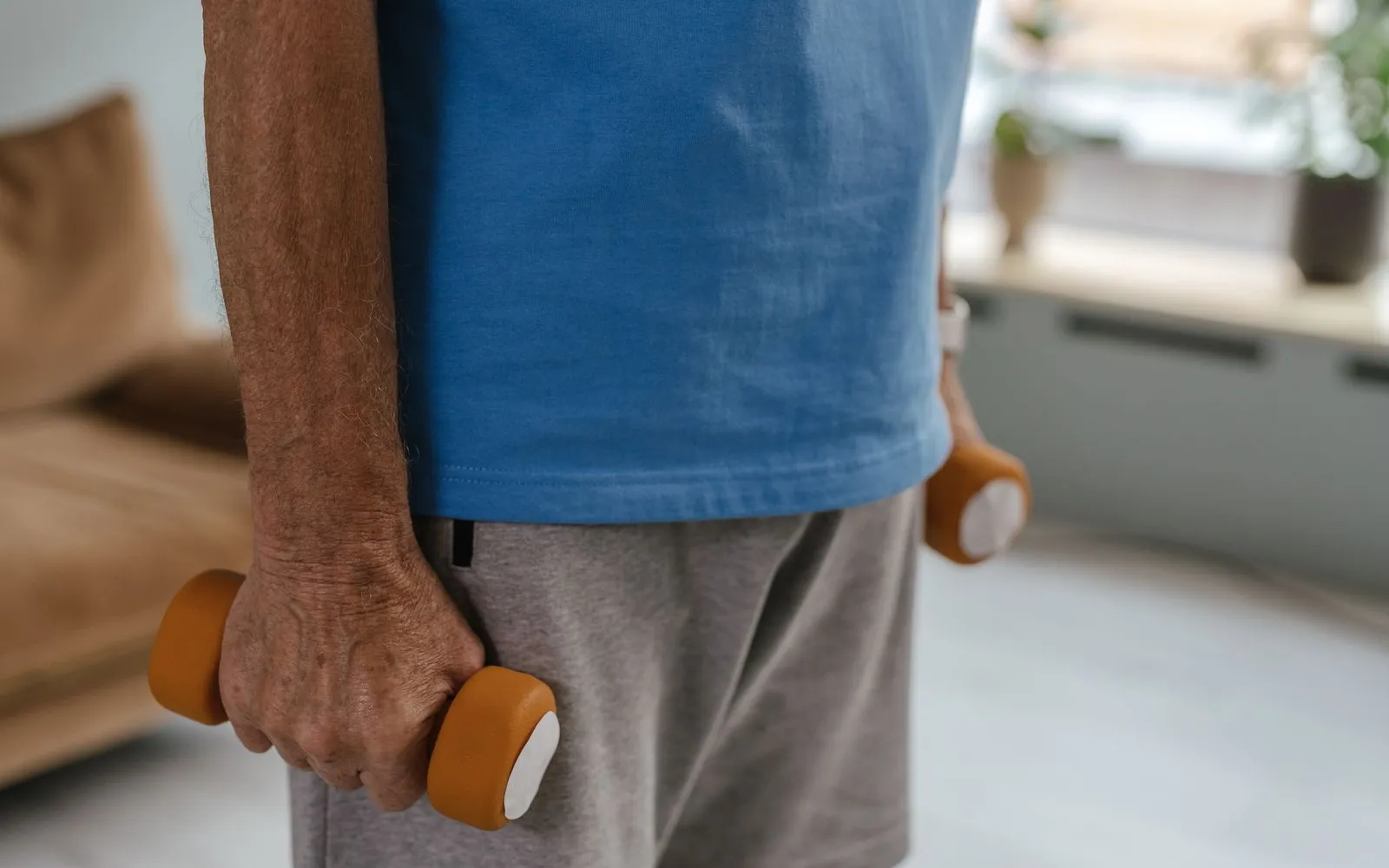
How often should seniors do strength training?
On at least 2 days a week. The NHS says adults 65 and over should do things that build strength, balance and flexibility on at least 2 days a week.
Work each move until you need a short rest before you go again. Heavy shopping bags, digging and resistance bands all count.
| How often | What to do | Examples |
|---|---|---|
| Every day | Some movement, even if it’s light | Making tea, dusting, a slow walk |
| At least 2 days a week | Strength, balance and flexibility | Weights, bands, tai chi, yoga |
| Across the week | At least 150 minutes of moderate activity | Walking, water aerobics, cycling |
| All day | Less time sitting or lying down | Get up and move between long sits |
Source: NHS
Strength work comes on top of your 150 minutes, not instead of it. Pick your 2 days now, with a rest day between them.
Strength and ab exercises for seniors at home
The Royal Osteoporosis Society splits moves into four groups: hinge, push, pull and squat. Do one from each group every session. Its first level suits everyone, including people with weak bones.
| Group | Easy start | How it works |
|---|---|---|
| Squat | Sit-to-stand | Stand up from a chair using your legs, not your arms. Sit down slowly. |
| Push | Wall press-up | Hands on the wall at chest height. Bend your arms, then push back. |
| Pull | Band row | Pull a band towards you, elbows close to your sides. |
| Hinge | Bridge | Lie on your back, knees bent. Lift your hips, then lower. |
Use a solid chair with no wheels. The NHS starts with 5 slow sit-to-stands and 3 sets of 5 to 10 wall press-ups.
Want ab exercises? The ROS adds a “brace” move, such as a kneeling side plank, once or twice a week. Have weak bones (osteoporosis)? Sit-ups, toe touches and Pilates curl-ups can put pressure on the spine.
Can’t get down to the floor? Try seated hip marching for your hips and thighs, 5 lifts each leg. Or use resistance band exercises in a chair.
How heavy should weight training for seniors be?
Heavy enough that 8 to 12 reps feel hard. The ROS says to build up to 3 sets of 8 to 12, on 2 to 3 days a week.
- Below 8 repsToo heavy. Try a lighter weight.
- 8 up to 12 repsAbout right. Stay here.
- Above 12 repsCould keep going? Go heavier.
Source: ROS
No weights? Filled water bottles and tins work. There’s no weight that is safe or unsafe for everyone. How you lift matters more than how much.
Age doesn’t stop it working. A Cochrane review of 121 trials in 6,700 older people found a large gain in strength, and getting out of a chair got easier. In adults over 50, harder training was linked to bigger gains.
Joint pain and sore muscles were common. Serious harms were rare. Add weight in small steps, as in progressive overload for beginners.
Does strength training stop falls?
Not on its own, as far as trials show. A review of people over 60 at home was uncertain about mainly-lifting plans. Mixed plans probably work better.
| Type of exercise | Effect on how often people fell | How sure |
|---|---|---|
| Balance and everyday moves | 24% fewer falls | High |
| Balance plus strength (mixed) | Probably 34% fewer falls | Moderate |
| Tai chi | May mean 19% fewer falls | Low |
| Mainly strength training | Not clear | Uncertain |
Source: Sherrington 2019 (Cochrane)
That one thing is balance work. Plans worked better when a health professional, usually a physio, ran them.
Add a balance move to each strength day. Start with our balance training guide.
A simple exercise program for seniors
Your first strength month
- Pick 2 or 3 days a week, with at least a day’s rest between them.
- Warm up, then do one squat, push, pull and hinge move each session.
- Start with 1 set of 8 to 12 reps and build up to 3 sets.
- Go lighter if you can’t do 8 with good form. Go heavier if you can do 12 and could keep going.
- Add a balance move to each strength day, and a brace move once or twice a week.
- Keep 20 to 30 minutes a session, and stop for a short rest between sets.
Feeling stiff or sore for a few days after is normal, especially at first. It usually eases as you get used to it. If you’re worried, or it doesn’t go away, contact your GP.
Not sure about form? The ROS suggests starting with a qualified instructor at a gym. Or follow our two-day strength routine.
When to speak to a GP
Stop exercising if you feel sick, dizzy or lightheaded, very short of breath, clammy or sweaty, tight in the chest, or any pain. Call 111 or 999 if you need urgent care.
- You haven’t exercised for some time, or you have medical conditions or worries. The NHS says to speak to a GP first.
- You’re worried about your balance or how well you move, or you’ve had a fall. See a GP.
- You’ve had many falls, broken many bones, have painful broken bones in your spine, or other health problems make exercise hard. The ROS says to see a physio.
- You’re not sure seated exercises suit you. The NHS says to check with a GP or a health professional involved in your care.
Call 999 if someone has fallen and may have hurt their head, back, neck or hip, or can’t get up. Call 111 if someone has fallen and may be in pain, hurt or unwell.