Fitness tests you can do at home
Count your push-ups and sit-ups in 1 minute. Then try a chair stand and a one-leg balance. But one online push-up chart says its source is unknown. So the score to beat is your own.
On this page
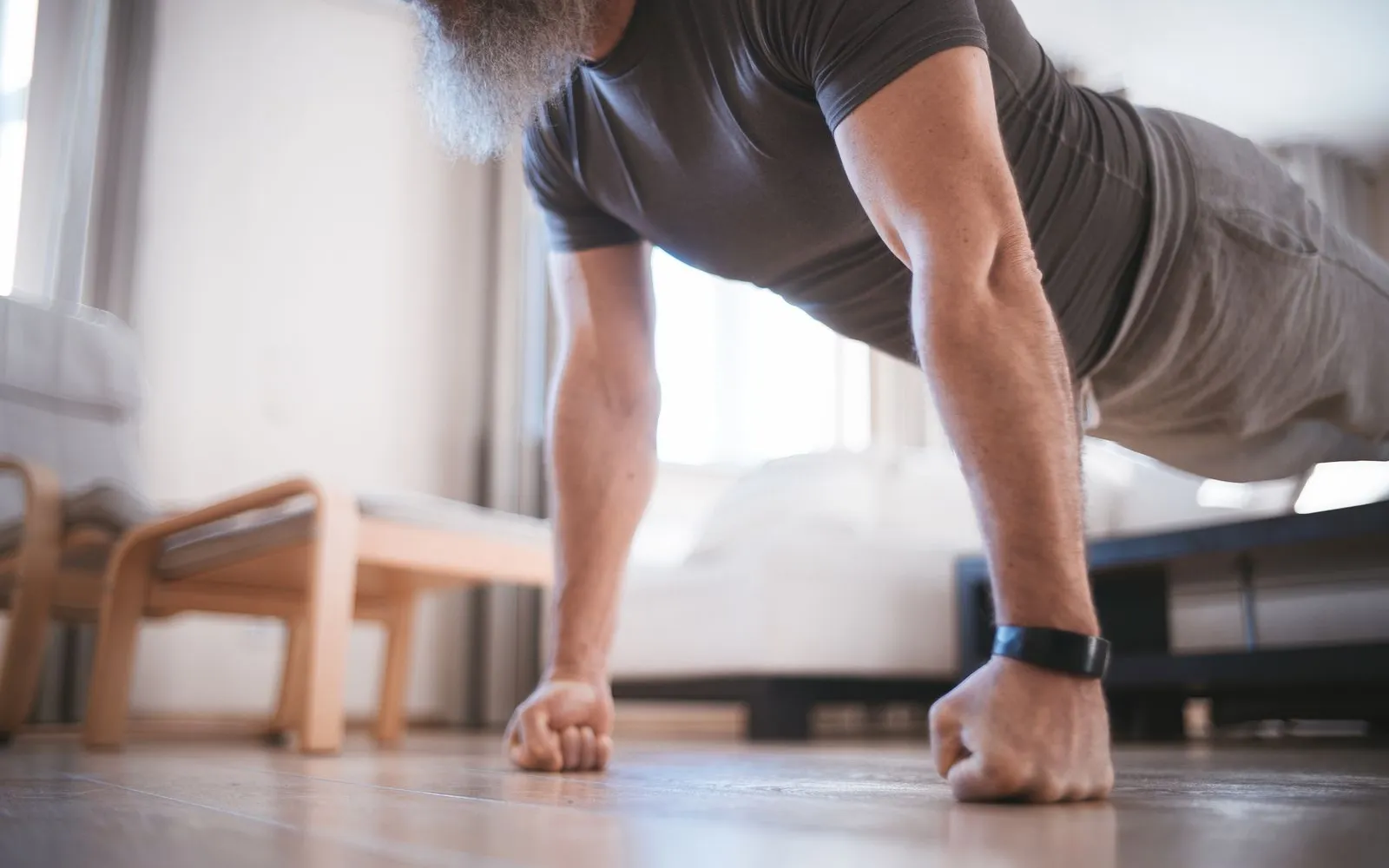
What is a fitness test you can do at home?
It’s a short set of moves you count or time. You need a floor, a chair without arms and a phone timer.
Each one checks a different part of fitness. Push-ups and sit-ups check muscle endurance: how long your muscles keep going. A chair stand checks leg strength and endurance.
| Test | What it checks | How to score it |
|---|---|---|
| 1 minute push-ups | Chest, shoulders and arms | Correct push-ups in 60 seconds. |
| 1 minute sit-ups | Tummy muscles | Correct sit-ups in 60 seconds. |
| 30-second chair stand | Leg strength | Full stands in 30 seconds, arms crossed. |
| One-leg stand | Balance | Can you hold it for 10 seconds? |
| Sit and rise from the floor | Strength and flexibility | Start at 10. Lose 1 for each hand or knee you use. |
Sources: NY State Police; CDC; Araújo 2022; Brito 2014
Want to test your heart and lungs too? Try the bleep test, or read how a VO2 max test works.
Write each score down today, with the date.
How to do the 1 minute push-up and sit-up tests
How to count a correct push-up
- 1
Start at the top
Hands about shoulder width, arms straight, body straight from shoulders to ankles.
- 2
Lower
Bend your elbows until your chest is about 10 cm from the floor.
- 3
Push back up
It counts only when your elbows lock straight at the top.
- 4
Rest only at the top
You may rest only in the up position. Tired before 60 seconds? Drop to your knees and keep going.
Source: NY State Police
These are the rules New York State Police use for their push-up test. Note if you dropped to your knees, so next time you compare like with like.
For the sit-up test, lie on your back with your knees bent at 90 degrees and heels on the floor. Curl up until your elbows touch your knees, then go back down until your shoulder blades touch.
Don’t lift your hips. You get one minute.
Police tests put your hands behind your head. Topend Sports, a fitness testing site, warns this can strain your neck, and suggests arms crossed over your chest. Don’t bounce off the floor.
A sit-up bleep test sets the pace with a recording instead. Like the running bleep test, the pace gets faster until you can’t keep up.
Pick one sit-up style and use it every time you retest.
Fitness tests for strength and balance
How to do the chair stand, one-leg stand and sit and rise
- 1
Chair stand: set up
Sit in the middle of a chair with no arms, about 43 cm (17 inches) high. Cross your arms on your chest. Have someone stand next to you for safety.
- 2
Chair stand: 30 seconds
Stand up fully, sit back down and repeat. Over halfway up when time runs out counts. Need your arms to stand? Your score is 0.
- 3
One-leg stand: 10 seconds
Stand on one leg with the other foot resting on the back of your standing leg, arms by your sides.
- 4
Sit and rise
Sit down on the floor and stand back up, using as little support as you can. Do both balance tests next to a wall or a sturdy chair in case you wobble.
Sources: CDC STEADI; Araújo 2022; Brito 2014
| Age | Men | Women |
|---|---|---|
| 60 to 64 | 14 | 12 |
| 65 to 69 | 12 | 11 |
| 70 to 74 | 12 | 10 |
| 75 to 79 | 11 | 10 |
| 80 to 84 | 10 | 9 |
| 85 to 89 | 8 | 8 |
| 90 to 94 | 7 | 4 |
Source: CDC STEADI
The US health agency CDC says a below-average chair stand score indicates a risk for falls. It gives no levels for under-60s, so track your own count.
In a Brazilian study of 1,702 people aged 51 to 75, 1 in 5 couldn’t stand on one leg for 10 seconds. Over about 7 years, 17.5% of them died, against 4.6% of those who could. The authors couldn’t account for things like recent falls or how active people were.
In 51 to 80 year olds, each extra point on the sit and rise test was linked to 21% better survival.
These studies show a link, not that the test causes anything.
Is my fitness test score good?
Push-up charts online rate you from poor to excellent. But Topend Sports says of its own chart that the original source for this data is unknown.
One long study followed 1,104 US male firefighters, average age about 40. They did push-ups to a beat and were followed for 10 years.
| Push-ups | Heart problems a year, per 100,000 men | Compared with 0 to 10 |
|---|---|---|
| 0 to 10 | 1,757 | Starting point |
| 11 to 20 | 625 | Lower |
| 21 to 30 | 288 | Lower |
| 31 to 40 | 433 | Lower |
| 41 or more | 79 | Lowest |
Source: Yang 2019, JAMA Network Open
Think of it like a weather forecast: odds for a group, not a promise for you. There were only 37 heart problems in total.
The authors say push-ups aren’t proven to predict heart risk on their own. The results may not apply to women, older or inactive people.
So write down your own first count and compare against that, not their table.
How to improve your fitness level
Six ways to beat your first score
- Do strength exercises for your legs, hips, back, tummy, chest, shoulders and arms on at least 2 days a week.
- Keep going on each exercise until you need a short rest before you repeat it.
- Can’t do a floor push-up yet? Start with wall press-ups: 3 sets of 5 to 10.
- Practise standing up from a chair using your legs, not your arms: 5 slow reps.
- Add 150 minutes of moderate activity a week, like brisk walking, or 75 minutes of vigorous.
- Retest once a month, at the same time of day, with the same rules.
Sources: NHS: adults 19 to 64; NHS: strength exercises
The NHS says to build up slowly and add reps over time. Aged 65 or over? Add balance work on at least 2 days a week too.
For full routines, see strength training at home, how to add reps and weight and balance training.
When to speak to a GP
In the firefighter study, men stopped if they felt dizzy, light-headed, short of breath or had chest pain. Do the same. Speak to a GP if:
- You haven’t exercised for some time, or you have medical conditions or concerns. The NHS says to speak to your GP first.
- You get chest pain that comes and goes, or goes away quickly but you’re still worried. The NHS says to see a GP.
- You’ve had falls. A GP can check your balance and may refer you to a falls service.
- You’re worried about your balance or mobility. The NHS says to see a GP.
Call 999 if you get sudden chest pain that doesn’t go away, like squeezing, pressure, burning or indigestion. Also call if pain spreads to your arm, neck, jaw, stomach or back, or comes with feeling sweaty, sick, light-headed or short of breath. These can be signs of a heart attack.
Call 999 if you fall and may have hurt your head, back, neck or hip, or you can’t get up. Get help from 111 if you’ve fallen and may be in pain, injured or unwell. See the NHS falls advice.