How do you make healthy pancakes?
Start with the topping: fruit, not syrup. One NHS pancake with apple is 162 kcal and 6.5 g of sugar. Yet 20 g of honey on top adds more than twice that sugar.
On this page
How do you make healthy pancakes?
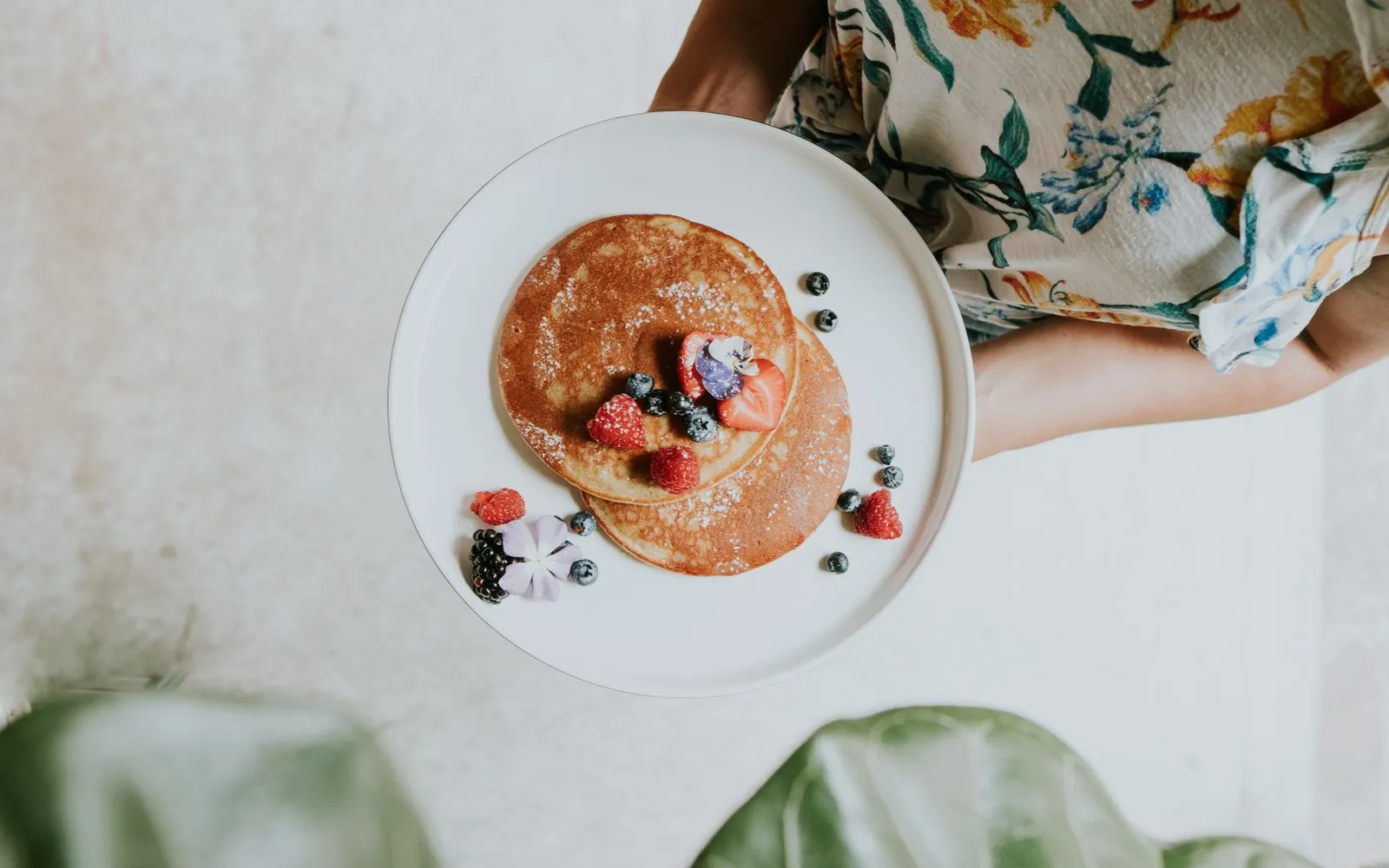
Keep the batter plain and change what goes on top. The topping moves the sugar more than anything else.
The NHS recipe makes 4 pancakes from flour, an egg, semi-skimmed milk and a little oil. Each one, topped with apple, has 162 kcal, 5 g of protein and 6.5 g of sugar.
Now add 20 g of honey. UK food tables put that at 58 kcal and 15.3 g of sugar. So most of the sugar is in the honey, not the pancake.
| Topping | Calories and sugar | Free sugar? |
|---|---|---|
| 80 g strawberries | 24 kcal, 4.9 g sugar | No |
| 100 g low-fat plain yoghurt | 57 kcal, 7.5 g sugar | No, it’s from milk |
| 10 g butter | 74 kcal, 0.1 g sugar | No |
| 20 g honey | 58 kcal, 15.3 g sugar | Yes |
| 20 g golden syrup | 60 kcal, 15.8 g sugar | Yes |
Sources: UK food tables (CoFID); NHS: sugar
Free sugars are the ones the NHS says to cut. Honey and syrups count, maple too. Sugar found naturally in milk and fruit does not, unless the fruit is juiced or puréed.
Adults should have no more than 30 g of free sugars a day. So 20 g of honey uses about half.
Top your next stack with berries and yoghurt. For the rest of your day, see how much sugar per day.
How do I make low calorie pancakes?
Measure the oil and skip the butter. Fat has 9 kcal a gram, more than twice the 4 kcal in protein or carbs.
Diabetes UK says 1 teaspoon of oil is enough for eight pancakes. Soak it into kitchen paper and wipe it round the pan.
Six swaps for healthier pancakes
- Leave butter out of the batter. Use spray oil, or 1 teaspoon wiped round the pan for eight pancakes.
- Use half plain and half wholemeal flour for more fibre, as the NHS recipe suggests.
- Swap some of the flour for porridge oats, a good source of fibre.
- Top with fresh fruit, natural yoghurt or chopped plain nuts instead of honey or syrup.
- Add eggs, quark (a soft low-fat cheese) or reduced-fat cottage cheese for more protein.
- If you have coeliac disease, use only oats labelled gluten free.
Sources: Diabetes UK; NHS: pancake recipe; NHS: fibre; Coeliac UK
The flour swap matters. Wholemeal flour has 10.1 g of fibre per 100 g, against 4.0 g for plain white, in UK food tables. Adults should aim for 30 g a day, but most get about 20 g.
No pancake can say “low calorie” on a pack. That needs 40 kcal or less per 100 g, and homemade sweet pancakes are 234 kcal per 100 g.
So count calories per pancake, toppings included. For more ideas, see low calorie breakfasts.
How do you make high protein oat pancakes?
Blend oats with eggs and quark. Flour pancakes are low in protein for their calories.
On a UK pack, “high protein” means at least 20% of the calories come from protein. “Source of protein” needs 12%. Protein has 4 kcal a gram, so 20% is 5 g of protein per 100 kcal.
- Below 3 gToo low to be called a source of protein.
- 3 to just under 5 gCan be called a source of protein.
- 5 g or aboveCan be called high protein.
Sources: UK nutrition claims law; UK food tables (CoFID); NHS: pancake recipe
We worked these out from UK food tables. A homemade sweet pancake gives 2.7 g and the NHS pancake with apple 3.1 g.
Our batter gives 8.8 g. Blend 40 g of porridge oats, 100 g of egg (about 2 eggs) and 100 g of quark, a soft low-fat cheese. The batch is 357 kcal and 31.6 g of protein.
Reduced-fat cottage cheese works too, at 15.6 g per 100 kcal.
Using protein powder? Check the label the same way. See protein powders and high protein breakfast ideas.
Can protein pancakes be gluten free?
Yes, if the oats are labelled gluten free. Oats don’t contain gluten, but they can cause a reaction if made in the same place as wheat, barley and rye.
Coeliac UK says “100% oats” or “pure oats” on a pack does not tell you if they’re gluten free. Only oats that test at 20 ppm (parts per million) of gluten or less can be labelled gluten free.
Most people with coeliac disease can eat gluten-free oats. A very small number still react to them.
So the oat and quark batter can be gluten free, as it has no flour. Just buy oats labelled gluten free.
Think you might have coeliac disease? Don’t cut out gluten yet.
The NHS says to keep eating gluten while you’re tested, so the tests are accurate. Don’t go gluten free until a specialist confirms it.
What about healthy waffles and French toast?
The same swaps work. Waffles start with more fat, so the oil and topping matter even more.
| Food, per 100 g | Calories and fat | Protein per 100 kcal |
|---|---|---|
| Sweet pancakes, homemade | 234 kcal, 7.4 g fat | 2.7 g |
| Waffles, homemade | 335 kcal, 15.3 g fat | 2.7 g |
| Wholemeal bread | 217 kcal, 2.5 g fat | 4.3 g |
Source: UK food tables (CoFID)
For high protein waffles, try the oat and quark batter in the waffle iron. It has the same 8.8 g per 100 kcal.
For French toast, start with wholemeal bread. The NHS suggests wholemeal or granary breads for fibre. Dip it in egg, cook it in a teaspoon of oil and top it with fruit, not syrup.
More ideas: overnight oats and healthy breakfast muffins.
When to speak to a GP
Speak to a GP if:
- You think you or your child may have a food allergy. Cows’ milk, eggs and wheat, all in pancakes, are among the most common.
- You get diarrhoea, stomach aches or bloating after foods with gluten. These can be symptoms of coeliac disease.
- You have coeliac disease and still get symptoms on gluten-free oats. Coeliac UK says to review them with your health professional.
- You have a medical condition, a special diet for your health, or an eating disorder now or in the past. Talk to a GP before changing what you eat.
Call 999 if someone’s lips, mouth, throat or tongue suddenly swell, or they’re breathing very fast or struggling to breathe.
Also call 999 if their throat feels tight or they struggle to swallow, or their skin, tongue or lips turn blue, grey or pale. On black or brown skin, this may be easier to see on the palms or soles of the feet.
Call too if they suddenly become very confused, drowsy or dizzy, or faint and can’t be woken. The same goes for a child who is limp, floppy or not responding.
If they have an adrenaline auto-injector or nasal spray, use it straight away. Then call 999, even if they seem to feel better.