How do I start Pilates at home?
Start with five floor moves. Do each one 8 to 12 times, breathing out as you move. The NHS counts Pilates as strength work. But a 12-week trial found two things it didn’t change.
On this page
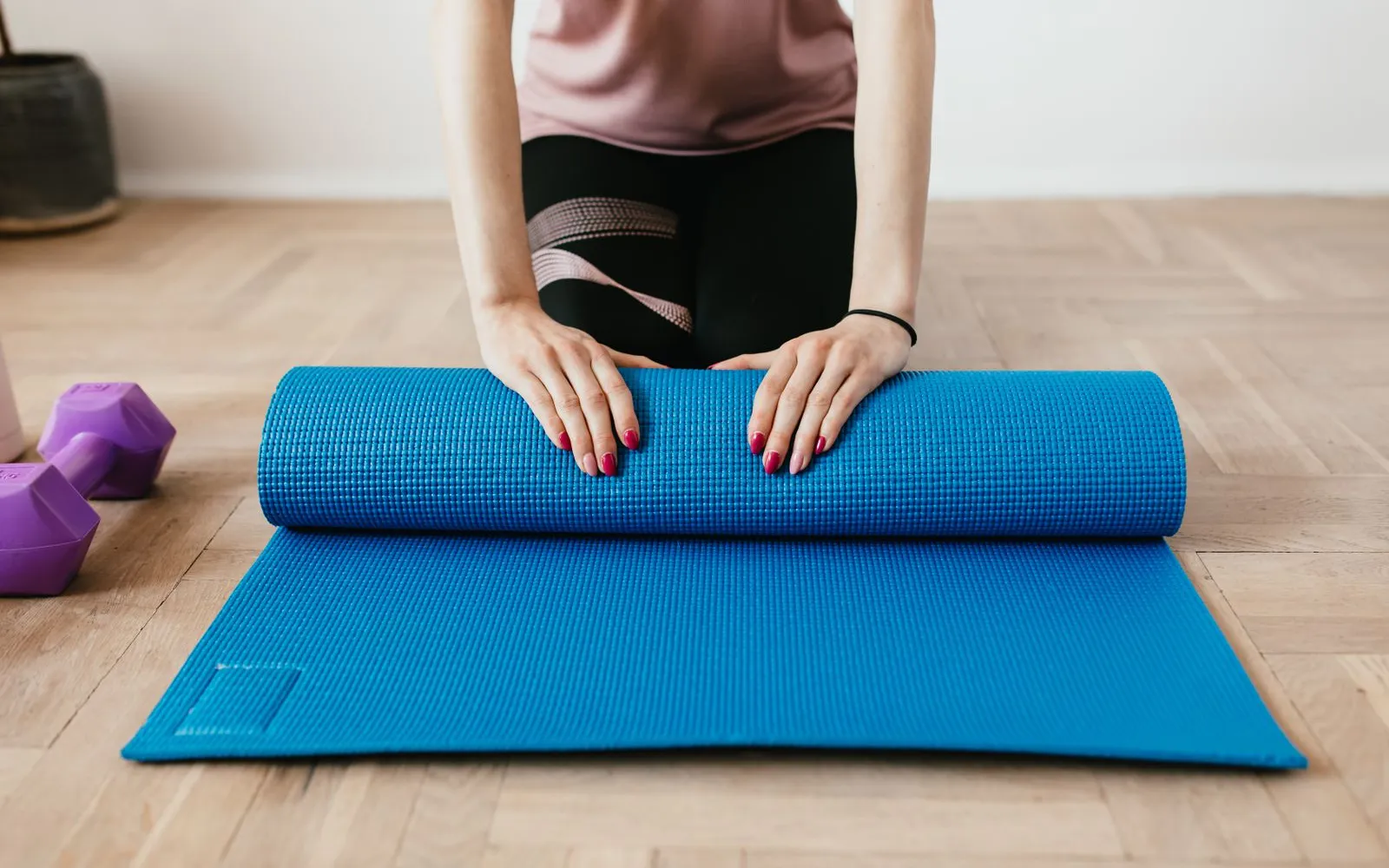
What Pilates exercises can I do at home?
Leg slides, heel taps, the bridge, the clam and the cat stretch. All five come from an NHS physio leaflet in Leicestershire. You need a bit of floor and nothing else.
Pilates is exercise that works on balance, posture, strength and flexibility. The NHS says it suits people of all ages and fitness levels.
| Move | How to do it |
|---|---|
| Leg slides | Lie on your back, knees bent, feet flat. Slide one heel along the floor until the leg is straight. Slide it back. |
| Heel taps | Same start. Lift one foot so your knee is over your hip and your shin is level. Lower it to tap the floor. Swap legs. |
| Bridge | Same start. Peel your back off the floor, one bit at a time, until you rest on your shoulder blades. Roll back down. |
| Clam | Lie on your side, knees bent to about a right angle. Keep your feet together and lift your top knee. Lower it. |
| Cat stretch | On hands and knees. Round your back up to the ceiling and tuck your head. Then let your back sink and lift your head. |
The same leaflet says to repeat each move 8 to 12 times. Breathe in to get ready. Breathe out as you move. Never hold your breath.
Before each move, find your middle spot. Your low back is neither arched nor flat. Don’t push your back into the floor.
Try the five moves today, slowly, and note any that feel hard.
What is a good Pilates workout at home for beginners?
Do the five moves in a set order, then stretch. A mat would be useful, and wear loose, comfy clothes.
A beginner Pilates workout at home
- 1
On your back
Leg slides, heel taps, then the bridge. 8 to 12 of each.
- 2
On your side
The clam, 8 to 12 each side.
- 3
On all fours
The cat stretch, slowly, 8 to 12 times.
- 4
Lie and stretch
Knee hugs (knees to chest), then knee rolls. Hold each 15 to 30 seconds.
For knee rolls, lie on your back with knees bent and together. Let them roll to one side, shoulders on the floor. Then go the other way.
The moves and holds are from the physio leaflet. The order is a simple start, not a study finding.
Prefer to follow along? The NHS has a free 45-minute beginners’ video. You don’t need to have done Pilates before.
Pick 2 days this week and put them in your diary.
How do I make Pilates moves harder?
Add a step to the move, not more speed. Once 12 slow reps feel easy, try the next level.
| Move | Harder version |
|---|---|
| Leg slides | Lift the leg so your knee is over your hip, then straighten it out. |
| Heel taps | Start with both legs up, knees over hips. Lower one at a time. |
| Bridge | At the top, lift your arms up or rise onto your toes. |
| Clam | Lift both feet off the floor, then do the same move. |
| Swimming (new) | Lie on your front, arms past your head. Lift one arm and the opposite leg. Swap. |
The leaflet says to work at a level that feels comfortable for you. Wobbling or holding your breath? Go back a step.
Done the beginners’ video a few times? The NHS pyjama Pilates class is for people with some basic experience.
Your Pilates week
- Do Pilates or other strength work that uses all your main muscle groups on at least 2 days a week.
- Do leg slides, heel taps, the bridge, the clam and the cat stretch, 8 to 12 times each.
- Breathe out as you move. Never hold your breath.
- Hold each stretch for 15 to 30 seconds.
- Once 12 slow reps feel easy, try the harder version.
- Stop straight away if you feel any pain or become unwell.
Sources: NHS; Leicestershire Partnership NHS Trust
Does Pilates count as strength training?
Yes. The NHS lists Pilates among muscle-strengthening activities, with yoga and lifting weights. Adults should do strength activities that work all the main muscle groups (legs, hips, back, stomach, chest, shoulders and arms) on at least 2 days a week.
To count, keep going until you need a short rest before the next go.
In one trial, 50 active middle-aged adults did a mat class twice a week for 12 weeks. Each class was an hour of about 25 basic moves.
| What was measured | Pilates group compared with no Pilates |
|---|---|
| Stomach muscle endurance | Better |
| Stretch in the back of the thighs | Better |
| Upper-body muscle endurance | Better |
| Posture | No change |
| Balance | No change |
Source: Kloubec 2010
Those two things were posture and balance. Muscles could keep going for longer, but neither of those improved compared with no Pilates.
A review of 11 trials compared Pilates with other exercise. It found no clear difference in strength, balance or flexibility, but the evidence was weak.
So Pilates counts, and it builds staying power. For heavier strength work, add moves from strength training at home or the glute exercises guide.
Is Pilates good for back pain?
It may help, but so may other exercise. A large review (Cochrane) of 10 trials in 510 people with low back pain found Pilates eased pain more than doing very little.
It found no clear proof it beats other exercise. The NHS physios agree, and say to choose something you enjoy.
Got long-term back pain? The NHS has a 29-minute Pilates class for it, but says to speak to a GP before you start. See also back exercises and core exercises.
When to speak to a GP
Have weak bones (osteoporosis)? The Royal Osteoporosis Society says the Pilates roll-down and curl-up can put pressure on the spine. Bend from your hips with a straight back instead.
Most of these moves are done on your back. In later pregnancy, the NHS says try to avoid lying flat on your back for more than a few minutes. It can make you feel dizzy and is not good for your baby.
The NHS says to stop straight away if you feel any pain or become unwell. If symptoms worry you or don’t go away, get help from 111.
Get advice from a GP or other health professional before you start if:
- You’re not sure the moves suit your fitness, or you have other worries about your health.
- You have a health problem, an injury or symptoms, or feel unwell. The same goes after a recent heart attack or operation.
- You’re pregnant or have recently given birth.
- You have back pain that hasn’t improved after a few weeks of looking after it at home. Also if it stops your daily life, doesn’t get better after resting, or is worse at night. Or if you’re worried about the pain or struggling to cope.
- Your back pain comes with weight loss you can’t explain, a lump or a change in your back’s shape. Also if it’s worse when you sneeze, cough or poo, or sits between your shoulders.
Ask for an urgent GP appointment or call 111 if you have back pain and feel hot, cold, shivery or generally unwell. The same goes for severe pain that starts suddenly or gets worse quickly.
Call 999 or go to A&E if you have back pain with pain, tingling, weakness or numbness in both legs. The same goes for loss of feeling around your genitals or bottom, or changes in your bladder or bowels.
Also call 999 if your back pain comes with chest pain, or started after a serious accident. Changes in how your penis or vagina feels during sex count too, as do erection or orgasm problems.